This is not a Roadmap

We are often asked about our plans for the future, and we would indeed love to discuss our plans in great detail. But there are so many reasons why it is in fact not such a good idea to publish detailed roadmaps. Today, I still would like to share a bit about what we are working on, while leaving a few secrets in the dark. After all, everybody enjoys a little surprise every now and then, right? ;)

Roadmap

Things for Mac

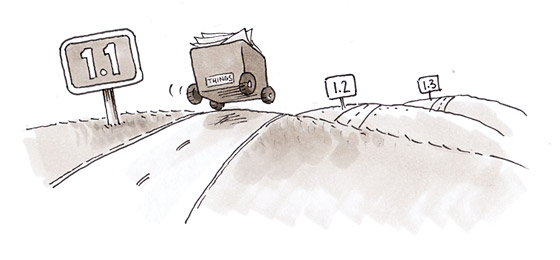
Our next release, Things 1.2, is due in about one or two weeks. Version 1.2 will be almost entirely about improving various aspects of keyboard support. Without going into the details here, let me just mention that 1.2 not only involves introducing many more keyboard shortcuts, but it also improves tabbing behavior when creating new to-dos, adds improvements for the quick entry window, provides support for Spotlight, and includes plug-ins for other apps. You might ask: "Why did those Cultured guys all of a sudden deem keyboard support that important?" Well, you'll see when we release 1.2 - this is one of the surprises mentioned above ;).

After version 1.2, it gets more interesting. The reason being that we will have more developer resources available to us! This means that we will be no longer doing one feature at a time. Instead, different development threads (or goals) will be followed simultaneously. Forthcoming articles will have more background on the extraordinary talent we were able to attract.

Here are our priorities for the next releases: Over-the-air sync, performance, bug fixes, easier collaboration, mixed projects, and better communication of how dates work. Let's flesh this out in a little more detail...

Believe it or not, we have been working on over-the-air sync since the beginning of this year. In the meantime, our goal changed from "something that works" (check out our competition if you want to know what we mean by that) to "a really sweet solution". The tough challenge here is to develop a highly performance-oriented solution that works for everybody. In particular, we wanted it to work for Mac and iPhone users alike, without requiring a MobileMe account (or any WebDAV disk for that matter).

The whole issue is indeed complex and interesting enough to warrant its own blog post, but suffice it here to say that we are well under way to providing the above-mentioned "really sweet solution" :).

Performance should be pretty self-explanatory. Users with large libraries are beginning to see sluggish behavior. This is unacceptable for an application whose foremost goal is to make you more productive. While Things 1.2 will already deliver some performance improvements, major attacks on all other performance related issues will be started immediately after finishing 1.2.

Collaboration is a very interesting problem space, and I think the importance of better support for teamwork in Things is pretty obvious. We will soon make a little step forward in this area to ease the workflow when working together. We are committed to constantly improve what we are doing here in the next few months and most likely well beyond.

For some users, mixed projects are a big deal. What we mean by this is the ability for active projects to also contain inactive and scheduled items. What seems to be an innocent change is in fact also a big deal for us as developers. When conceiving Things, we very deliberately did not want to have mixed projects. We so much didn't want it, that we even made the decision on the level of our data model design for both the Mac and iPhone version. This is the reason why we kept postponing the implementation of these improvements.

Things for iPhone and iPod touch

Let me close this non-roadmap with, uhh… a roadmap for Things touch:

  • 1.4: Repeating tasks, global search, landscape mode
  • 1.5: Push notifications, polish
  • 1.6: People support

Things Wins Apple Design Award 2009

Tuesday, June 9th 2009 was a special day for Cultured Code. You might have already heard about it if you are following us on Twitter. During the week of June 8th, Apple held its annual World Wide Developers Conference (WWDC) in San Francisco.

This year, an unbelievably large crowd of more than 5000 developers went to the Moscone West conference center to get the latest scoop on Snow Leopard and iPhone OS 3.0, along with meeting Apple engineers and bombarding them with questions.

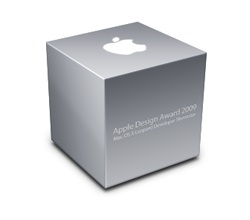
The evening of the second day of WWDC is traditionally reserved for celebrating the winners of the Apple Design Award (ADA). The trophy is a very elegant cube with a transparent Apple logo that lights up when you touch the cube:

Apple Design Award

Receiving an ADA is the dream of every Mac and iPhone developer. While not as glamorous as the Oscars - we are developers after all! - the significance of the ADA for the Mac community is not unlike that of an Oscar for the film industry.

Before we flew to San Francisco, we tried to convince ourselves that we had an actual chance of winning, but our hopes dwindled when we sat among thousands of other developers that Tuesday evening. With so many other contestants, receiving an ADA felt virtually impossible. But it happened! When Things was announced as a winner, we all shared a frozen moment in time - it was a dream come true.

Winning Apple Design Award
Image courtesy of Hussein Morsy

Being awarded a prize for design excellence from a company like Apple means an awful lot to us. We are happy and proud; but most of all, it is an encouragement to continue to do the best job we possibly can.

Things 1.1.2 and Things touch 1.3.5 Released

Now that Things 1.3.5 for iPhone and iPod touch has been approved by Apple and is now available on the App Store, we are announcing the release of Things 1.1.2 for the Mac.

Things

Besides a host of bug fixes and smaller changes, there are three major areas of improvement which are important enough to deserve their own blog posts:

There are also many smaller (but not less important) improvements we couldn’t fit into one of the articles linked to above. Some of them fix issues that were driving some of our users crazy, such as keyboard shortcuts. ⌘S is no longer used to move a to-do to the Someday list. While the letter “S” is certainly not completely unrelated to the word “Someday” ;), pressing ⌘S is too deeply associated with saving a document in many user’s muscle memory. Therefore, the keyboard shortcut ⌘Y now toggles the active/inactive state of an item, moving next-action steps and active projects to Someday, or - vice versa - items from Someday back to the Next or Active Projects list.

Another keyboard shortcut that has changed is ⌘→ to bring up the dialog for moving items. The new shortcut is ⇧⌘F. The letter “F” refers to the corresponding menu command “File…”.

Due dates! There are so many different ways for using, or even not using, due dates to get organized. Some users found themselves having many overdue items, but ended up being reluctant to move the dates farther into the future. After all, changing a due date is probably not going to help you reach your goals earlier next time. Previously, when you you set an overdue item to “Not Today”, it was still moved back to the Today list when you re-opened Things or when you synced with your iPhone or iPod touch. The new versions of Things for the Mac and Things for iPhone and iPod touch will instead keep the items in the Next list until the next day.

If you are syncing with your mobile device, please be sure to update both Things for the Mac and Things for iPhone and iPod touch to get a consistent behavior across sync sessions.

Other improvements include:

  • A faster and more reliable software update mechanism
  • A unified way to send support inquires
  • An updated iPhone preference pane that provides even more help and feedback to new users
  • A more robust mechanism for discovering and pairing the desktop version of Things with its mobile sibling, in particular with busy networks

Don’t miss our more detailed articles below, and please don’t forget to download the new version of Things for iPhone and iPod touch. On both your mobile device and iTunes you might have to manually check for updates before Things touch 1.3.5 shows up. Enjoy!

Things 1.1 Brings Extensive AppleScript Support

No Mac application can truly be considered complete without AppleScript support. We are very happy to announce that version 1.1 of Things brings full scripting support for most aspects of the application. But hold on a second, isn't AppleScript only relevant for programmers? And what is AppleScript anyway?

Apple Script

AppleScript is part of Apple's automation technologies. It is an English-like language used to write little applets that can control the actions of a computer and applications that run on it. Here is an example:

tell application "Things"
    set message to the name of the first selected to do
end tell
 
tell application "Twitterrific"
    post update message
end tell

While it may seem obvious what this script will do, let's break it down for you. We'll assume you have selected one or more to-dos in Things. We will also assume that you have a Twitter account and the Iconfactory's Twitter client Twitterrific installed on your Mac, configured for the Twitter account. The above script will ask Things to return the name of the first selected to do. Then, it will make "message" a shortcut of the returned text. That text is now handed to another application - Twitterrific in our case - to post it as an update to your Twitter account.

It is easy to try the above script yourself. Just fire up Apple's Script Editor application which is already installed on your system. Copy and paste the above script into an editor window and click the run button in the tool bar. Oh, and you may want to make sure that a suitable to do is selected in Things ;)

Of course, you don't need to use the Script Editor every time you want to use a script. You can save your scripts and then run them by simply double-clicking them. Even more convenient, you can drag scripts into the Finder's toolbars for easy access. For an example, check out the Browse Full Screen script from Apple's website.

We have a section in our wiki dedicated to collecting user contributed scripts. If you are interested in automating Things, be sure to check it out every once in a while. Our Things AppleScript Guide, which you will also find there, is filled with snippets of example code which will get you started in no time. Happy scripting!